Top Brake Choices for Long-Distance Riders
If you’ve ever finished a long ride with aching hands and forearms that feel more tired than your legs, chances are your brakes had something to do with it.
Most riders don’t think much about brakes until something feels off. A bit of squeal in the wet. Needing a harder squeeze on descents. That slight moment of hesitation when you’re tired and approaching a junction faster than you’d like. On shorter rides, you shrug it off. On longer rides, those little issues start to add up.
When you’re riding distance — real distance — brakes stop being just a safety feature. They become part of your comfort, your confidence, and how relaxed you feel on the bike hour after hour.
Long Rides Change What You Expect From Brakes
Early on in cycling, most of us think braking is simple. Pull the lever, slow down, stop. Job done.
But long-distance riding changes that perspective. When you’re several hours in, your hands are tired, the road surface is unpredictable, and the weather’s doing what it usually does in the UK, you start wanting brakes that feel calm and predictable rather than aggressive.
Good long-distance brakes:
- Respond the same way every time
- Don’t require a death grip to work well
- Stay consistent in rain and grime
- Let you relax instead of constantly adjusting
It’s not about raw stopping power. It’s about trust.
Rim Brakes: Still Familiar, But Not for Everyone
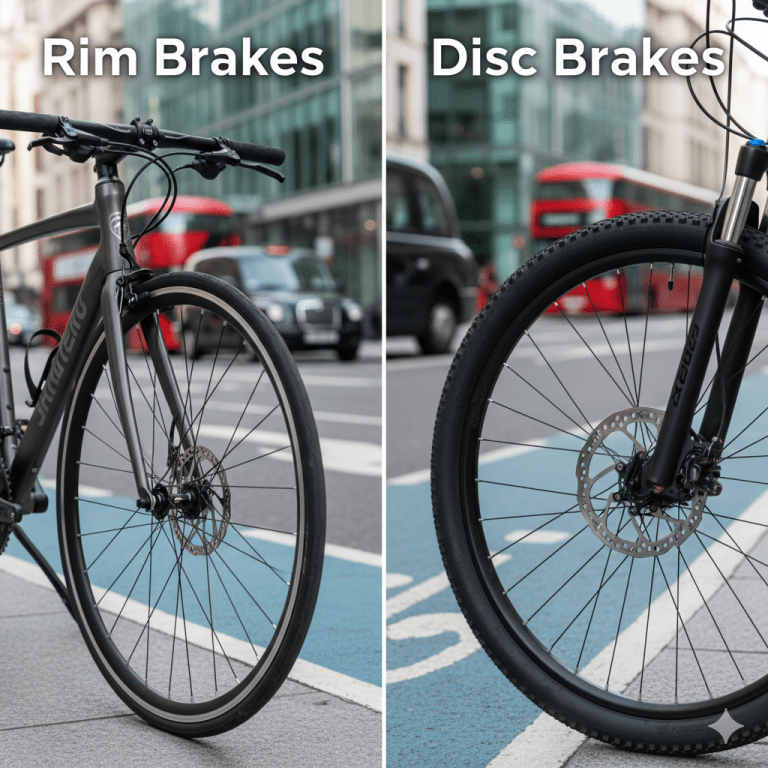
Rim brakes still suit plenty of riders. They’re simple, lightweight, and easy to live with. For fair-weather road riding and lighter setups, they can work perfectly well.
But on long rides — especially in mixed UK conditions — their limits show sooner. Wet roads, gritty descents, and long braking sections can all reduce confidence. You find yourself squeezing harder, thinking more, and working around the brakes instead of letting them quietly do their job.
For some riders, that’s fine. For others, it’s the reason they start looking elsewhere.
Disc Brakes: A Natural Step for Distance Riding
Disc brakes didn’t take over overnight — but there’s a reason so many long-distance riders have gravitated towards them.
The biggest difference isn’t drama or power. It’s consistency. Braking feels the same whether the road is dry, damp, or properly soaked. That predictability takes pressure off your hands and your head, especially late into a ride.
On long descents, that steady feel matters more than people realise.
Mechanical Disc Brakes: Simple and Dependable
Mechanical disc brakes suit riders who want better performance without extra complexity. They’re straightforward, reliable, and easy to maintain — which matters when you actually ride your bike regularly instead of treating it like a museum piece.
For touring riders, commuters who ride long miles, and anyone who values practicality, mechanical discs often make sense. They offer a noticeable improvement over rim brakes while still being easy to live with.
Hydraulic Disc Brakes: Comfort You Feel After Hours, Not Minutes
Hydraulic brakes tend to win over long-distance riders for one main reason: effort.
You don’t notice it straight away. But after a few hours, when you’ve been braking repeatedly, that lighter lever feel becomes a gift. Less squeezing, less tension, less fatigue.
It’s not about riding faster. It’s about finishing a ride feeling like your hands haven’t been doing extra work all day.
Brake Feel Is More Important Than Most Riders Admit
Two brakes can look identical on paper and feel completely different on the road.
On long rides, bad brake feel is draining. Grabbing too sharply. Feeling vague. Needing constant micro-adjustments. All of that adds mental noise when you’d rather be enjoying the ride.
Good brakes fade into the background. You don’t think about them — you just trust them.
Why Long-Distance Riders Are Quietly Choosing Laxzo
A lot of riders don’t want hype. They want parts that work, last, and make riding easier rather than more complicated.
That’s where Laxzo has found its place with long-distance cyclists. The focus isn’t on shouting about performance numbers — it’s on building braking components that feel right in everyday UK riding.
Riders notice that Laxzo brakes:
- Perform consistently in wet conditions
- Feel predictable when tired
- Hold up well over time
- Don’t demand constant adjustment
- Come without inflated pricing
It’s the kind of quality you appreciate gradually, over miles, rather than in a five-minute test ride.
Designed for Real UK Riding, Not Ideal Conditions
UK roads are rarely perfect. You deal with rough tarmac, sudden showers, long rolling descents, and unexpected stops. Brakes need to cope with all of it, calmly.
Laxzo’s braking setups reflect that reality. They’re built for reliability first — the sort that matters when you’re far from home and just want everything to work as expected.
Choosing Brakes That Match How You Ride
There’s no single best brake — only the best one for you.
- Mainly road riding, fair weather → Rim or mechanical disc
- Mixed conditions, long miles → Mechanical disc
- Hilly routes, endurance focus → Hydraulic disc
- Touring or loaded riding → Robust, low-maintenance systems
The right choice is the one that supports you when fatigue sets in, not just when you’re fresh and flying.
Final Thoughts: Good Brakes Let You Relax
On long rides, confidence is everything. When your brakes feel smooth, predictable, and effortless, the whole ride feels calmer.
That’s why more long-distance riders are choosing Laxzo — not because it’s loud about itself, but because it quietly does what riders actually need.
Good brakes don’t demand attention. They earn trust.
And on long-distance rides, that trust makes all the difference.